1969–1973
The case Neil helped build
The 1972 investigation into the Brotherhood of Eternal Love.
By 1972, the case Neil had worked on in Laguna had grown well beyond Laguna Canyon. Investigators from several agencies were piecing together travel records, shipping papers, local police reports and witness testimony in the investigation of the Brotherhood of Eternal Love.
In this chapter
- The Brotherhood of Eternal LoveLate 1960s and early 1970s
- The routes investigators followedEarly 1970s
- The case reaches MauiEarly 1970s
- A shipping record becomes evidence1972
- Robert Romaine’s testimony1972
- Orange Sunshine in the filesMarch 1972
- The amended indictmentAugust 1972
- Laboratory and business records1972
- Recognition from SacramentoAugust 18, 1972
Background
The Brotherhood of Eternal Love
Late 1960s and early 1970s
The Brotherhood of Eternal Love grew out of the Southern California counterculture and became the target of a major narcotics investigation. Over the years a lot of legend built up around the name, and FBI files and later news stories say different things about the group.
From the family archive
The routes investigators followed
Early 1970s
The investigation stretched from Southern California to Hawaii and ports overseas. Because of that, local police reports ended up in the same files as travel and shipping records from far away, and several agencies worked the case together.
From the family archive
The case reaches Maui
Early 1970s
The investigation reached Hawaii. In 1972, officers worked together on an operation in Maui, and intelligence reports came in from the islands.
In the family archive
Top 100 catalogue, selections 048, 049 and 061, pages 58–59 and 71.
From the family archive
A shipping record becomes evidence
1972
Investigators traced a vehicle shipment, and its shipping record was entered as an exhibit during testimony. An ordinary piece of cargo paperwork helped show what happened and when.
In the family archive
Top 100 catalogue, selections 050 and 051, pages 60–61.
From the family archive
Robert Romaine’s testimony
1972
Laguna Beach police officer Robert Romaine testified about overseas travel and photographs. A local officer’s work had become part of a much bigger case.
In the family archive
Top 100 catalogue, selections 052–054, pages 62–64.
From the family archive
Orange Sunshine in the files
March 1972
By 1972, the name Orange Sunshine was turning up in undercover reports and in sworn testimony. Later, people used it as shorthand for a much bigger story. The Ninth Circuit’s ruling in the Sand and Scully appeals was a separate case.
In the family archive
Top 100 catalogue, selections 073–079, pages 84–90.
From the family archive
The amended indictment
August 1972
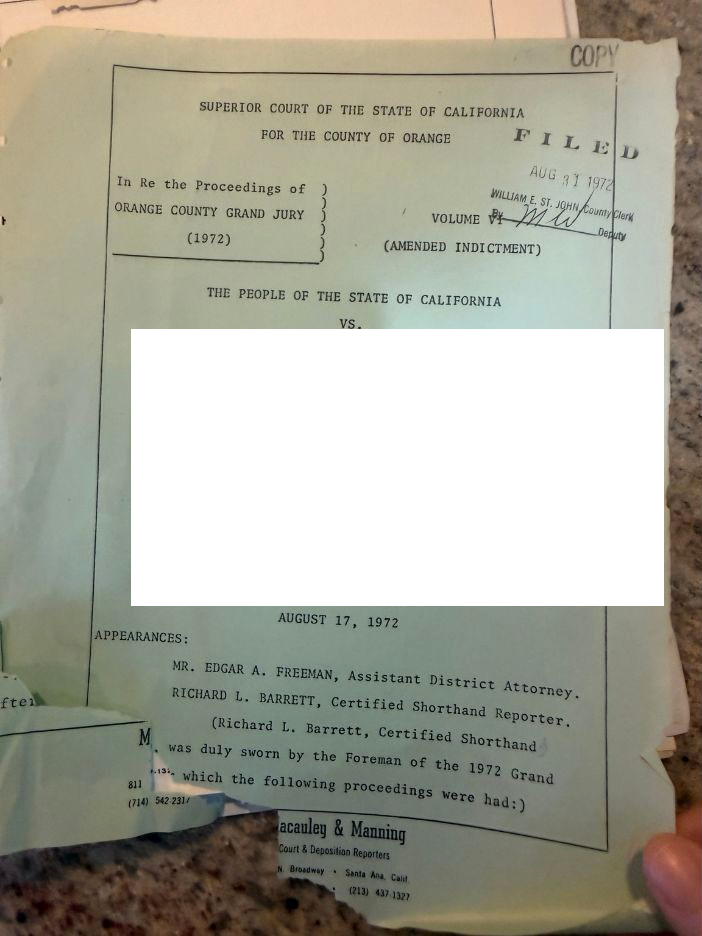
Purcell family archive, page 15. Filed August 17, 1972. Existing redaction retained.
An amended indictment was filed on August 17, 1972, as part of the Orange County Grand Jury proceedings. It set out accusations, not findings of guilt.
In the family archive
Top 100 catalogue, selection 063, page 74.
From the family archive
Laboratory and business records
1972
Much of the case came down to paperwork. Lab examiners, record keepers and other witnesses testified about lab comparisons and business records: where each record came from and what it showed.
From the family archive
Recognition from Sacramento
August 18, 1972
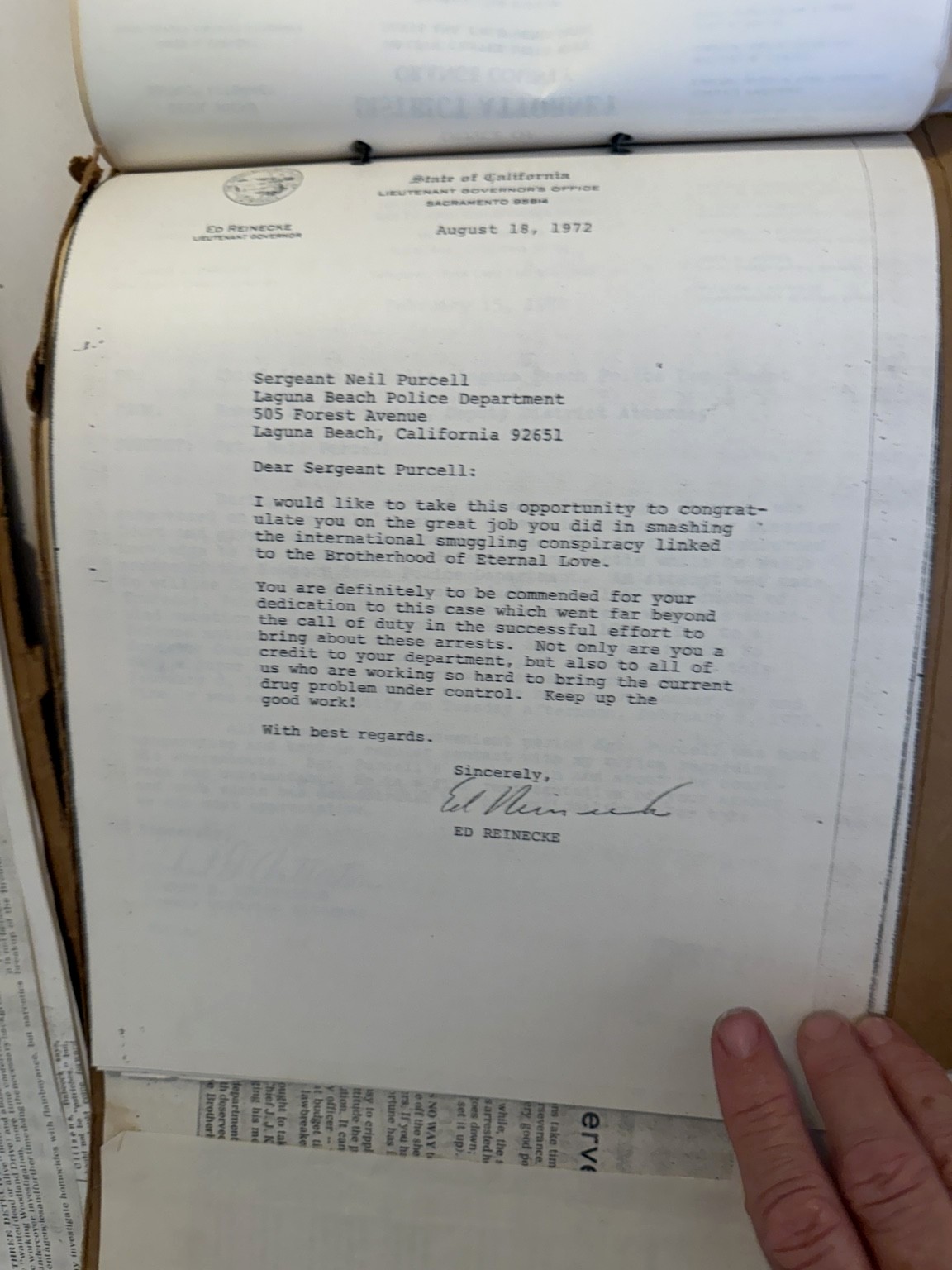
Purcell family archive, page 13.
On August 18, 1972, California Lieutenant Governor Ed Reinecke wrote to congratulate Neil on his investigative work. Neil’s family kept the letter with the recommendations he received.
In the family archive
Top 100 catalogue, selection 083, page 95.